

March 2023 | Volume 18 | Issue 3
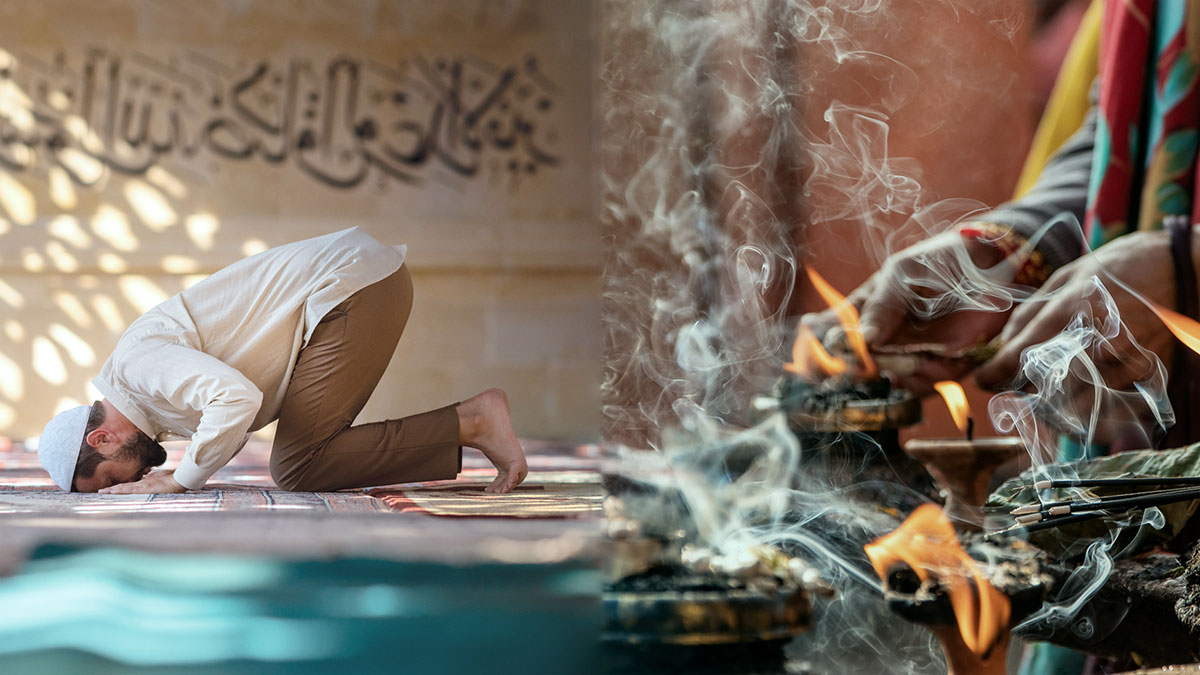
How to visit a Mosque or Temple
Creating a perspective-changing experience for your church
I’ll never forget the experience that radically changed my view of Hindus in America. One minute I was standing on a typical streetcorner in New York City. The next, I was transported to another world as I stepped inside a Hindu temple.
The smell of incense hung heavy in the air, and plates of food offerings sat before idols of various sizes. Melodic chanting added to the otherworldly atmosphere. Men with containers of milk were bathing some of the idols as a form of respect and worship. Clusters of men and women sat on the floor facing one or another of the idols, some of which had intimidatingly fierce appearances. With hands clasped in worship, these people seemed oblivious of our group of wide-eyed visitors.
The Power of Personal Encounter
My head reeled. Was this really New York City? Wasn’t the worship of idols something long past or limited to places like India? These looked like typical Asian-Americans, yet they obviously believed that these wooden idols had the power to help them. The words of the psalmist played in my head, “Their idols are silver and gold, the work of human hands. They have mouths, but do not speak; eyes, but do not see. They have ears, but do not hear.” (Psalm 115:4-6)
That visit occurred several decades ago, yet the memory is very clear. It changed my perception of a large portion of the peoples God was bringing to America. Our tour included not only this Hindu temple, but also a Muslim mosque and a Sikh temple. Each place of worship reinforced the fact that our diaspora neighbors may be embracing American lifestyles, learning English, and integrating into our communities, but they are still committed to the gods and religious beliefs they had brought with them to their new country.
“Our diaspora neighbors may be embracing American lifestyles, learning English, and integrating into our communities, but they are still committed to the gods and religious beliefs they had brought with them to their new country.”
The people in your church will also be impacted if they have the opportunity to see devout Muslims, Hindus, Buddhists, or other religious groups in worship. No plane ticket or visa is needed because today most churches are within easy reach of one or multiple mosques and temples. Organizing a visit to a place of worship for another religion is relatively easy. In almost all cases, the spiritual leaders are warm and welcoming to visitors. Muslims, in particular, are eager to welcome guests because they want to erase any perception that all Muslims are violent extremists.
We talked to several missions leaders with extensive experience in organizing church visits to places of Hindu/Muslim/Buddhist worship. Here are their suggestions.
Planning Your Visit
Gary Eberly (Brandywine Grace Church, Downingtown, PA): Our first mosque visits were led by a cross-cultural worker here in Philadelphia who had built extensive relationships with Muslims in his community. He arranged everything and provided the orientation. More recently, we have been organizing our own visits. We have done several weekends that we call “Nations Among Us” where on a Saturday we provide an orientation and visit a mosque, and on Sunday afternoon we visit a Hindu temple.
In advance of a mosque or temple visit, we connect with the leader, explaining that we are from a church and that we want to come and learn about their religion and experience their culture. We try to communicate that the people of our church are pleased that they are in our neighborhood and that we want to better understand them.
Dave (Last name withheld for security purposes, Park Community Church, Chicago, IL): We always make arrangements in advance with the imam or whoever is the leader of that particular place of worship. No one has ever refused our visit, but it’s best if the leader from your church goes in person to ask permission to bring the group. This personal visit begins to establish a rapport that can open doors in the future.
Andy Smith (Name changed for security purposes): We plan a different experience for the teams that come to us for a weekend of intensive exposure to unreached peoples. We take groups to an ethnic market run by followers of animism or to another that includes a mosque within it. This provides exposure not only to religious activities but also to other cultural aspects. We also often take groups to a Buddhist temple.
“Today, most churches are within easy reach of one or multiple mosques and temples.”
Before the Visit
Dave: Our groups don’t typically include younger children, but teenagers from junior high and up have benefitted and participated well. Our experience begins with an orientation time at the church. This typically runs about half an hour, and I use a one-page handout laying out the basics of Islam (or Hinduism or Buddhism if we are visiting a temple). We also explain what our group can expect when they get to the mosque, for example that they will be asked to leave their shoes at the door. We also tell them that there will likely be aspects of the visit that we didn’t anticipate, but if they aren’t sure what to do, to simply follow the example of the leader. It is also okay to ask the host what is appropriate to do.
Andy: Our day begins with some biblical background and an introduction to Islam, Buddhism, and/or animism, depending on where we are visiting. We also make sure that participants understand that they are going to be guests and cultural learners, not evangelists, in this interaction.
Gary: If we are visiting a mosque, we encourage people to dress especially modestly. For example, long dresses are appropriate for women; skinny jeans are not. Long sleeves are preferred. It might be wise for women to take a head covering although they may not need to wear it.
The Visit Itself
Gary: We always ask if we can schedule our mosque visit to coincide with one of their times of prayer. This timing not only gives us an opportunity to see Muslims at worship but also it often allows us to interact afterward with a number of members of the mosque. On occasion, they have asked us to stay for a light meal with them.
A regular prayer service may be 20-30 minutes long. We sit quietly in the back and respectfully observe. The leader may speak English at times, possibly for our benefit, but all of the prayers are in Arabic. Men recite portions of the Koran as they kneel with foreheads touching the carpet.
During Ramadan, the leaders of a nearby mosque have invited us to an Iftar, the meal that breaks the fast at sunset. The visit will include a speaker explaining Islam and their beliefs, and then a prayer time at sundown
followed by a big feast. We have found that these Iftar events are great opportunities to interact with members of the mosque throughout the evening.
Dave: We let our group know ahead of time that at the mosque men and women usually must sit separately. Sometimes they are in the same room with a curtain preventing each group from seeing the other. In other cases, the women are in an entirely separate room. There is often a question-and-answer time with the imam after his presentation. On one visit to a more conservative mosque, the women were told that if they had a question, they would need to write it down and push it under the curtain to the men’s side.
Then one of the men would read it aloud. That definitely made an impression on our group!
Gary: Our welcome at a Hindu temple is more subdued. While generally they are not looking for opportunities to host non-Hindus, we have found that they are willing to set it up and have a speaker. There is no organized prayer or worship service as people just drop in and do their own prayers. Observing people actually worshipping idols is very powerful to experience.
Andy: Our teams interact with businesspeople in the various markets as well as visit the places of worship. We make sure that each person has money to spend at the market as a way to demonstrate goodwill to the vendors. We alert our group to watch for, but not buy, any fetishes, charms and objects used by shamans in their incantations. We also purchase our meal at the market, providing more opportunities for interaction with those who work there.
“A short-term team from our church joined one of our partners serving refugees. During their time there, they visited a nearby mosque attended by some of those they were serving. The experience provided a valuable glimpse of these refugees’ religious life.” —Stacy Tertany, Missions Director, The Shoreline Church, San Clemente, CA
After the Visit
Dave: We follow up the mosque or temple visit with a meal at a nearby ethnic restaurant where we can debrief the experience, being aware that we need to be wise in what we say if there are adherents to the faith within earshot. If possible, we have with us a worker with experience in Muslim ministry to help debrief the experience and answer questions. We distribute a handout with some ideas to help us unpack the experience and consider what’s next.
Gary: We always try to do a debrief after the visit. We may pick up an ethnic takeout and meet back at the church to have freedom to talk. We want to know how they are feeling about their visit and answer questions. We wrap up our debrief with prayer for those we observed in worship, asking God to open their eyes to His truth.
Before we conclude, each participant is encouraged to consider next steps. It may be prayer walking their neighborhood, especially if Muslims or Hindus or people of other religious blocs live there. We encourage them to initiate friendly conversations with diaspora neighbors and others they meet in the community.
We alert our people to upcoming Hindu community festivals such as Holi or Diwali which are becoming more popular in our area as the Hindu population increases. These festivals are a great way to introduce children to the culture of Hindu neighborhood children and classmates.
Take the Initiative
Ask the people in your congregation and it is likely that most will confirm that Muslims, Hindus, Buddhists, and members of other religious groups have become their neighbors and work colleagues. Most church members are curious about these newcomers but fearful too—afraid of saying or doing something that might offend. Some may be unsure whether even entering a mosque or temple is inappropriate for a believer until they understand that the purpose is to learn, not participate in any worship rituals.
Leading a group on a visit to a mosque or temple is a great first step to breaking down the fear barriers. It also creates a sense of urgency in the hearts of believers who, maybe for the first time, are seeing worshippers chained in empty rituals and spiritual darkness. God can use this experience as the first step in building relationships. Who knows what eternal impact will be launched by your temple or mosque visit!
Use the button below to access some debrief discussion questions, background information on Hinduism, Buddhism, and Islam, and short summaries on “How to Share Your Faith” with each group.