

January 2024 | Volume 19 | Issue 1

Multi-Generation Advantages
How three perspectives benefit one church’s missions
Like many churches, Crossroads Fellowship in Raleigh, NC, has recently had major staff transitions. Leaders from younger generations replaced Boomers in key positions, including those guiding their missions engagement. But unlike some congregations where baton-passing has precipitated a major loss of missions momentum, Crossroads’ changes have resulted in stronger missions. Why?
Last month, Catalyst initiated a dialog with Andy George, senior pastor from the Gen X generation; John Frye IV, missions pastor from the Millennial generation; and Doug Gamble, former missions pastor and now city reaching pastor who is a Boomer. We hope you sense the synergy that was palpable during this conversation as you read this Postings issue. Don’t miss the important questions at the end.
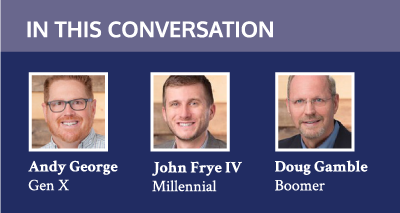

Catalyst: Crossroads has recently completed a series of major staff transitions that brought each of you into a new leadership position. You are shaping the church’s local and global impact as leaders from three very different generations. What has made the transition and the new teamwork successful?
Doug Gamble, Boomer
 I’ll provide a little history. The transition from our previous senior pastor who was a Boomer to Andy, a Gen Xer, went incredibly well. I believe this was because we have a really healthy church culture. It’s that culture that keeps us here. We don’t always have a master plan, but we have clear directions, convictions, and values.
Our missions program has a focus on church-to-church, pastor-to-pastor, disciple-making movements. That’s our bullseye. Andy’s already got a heart for that, and it’s a good fit for his gifts. He’s probably gone overseas 20 times across his years at Crossroads. Since he’s now the senior pastor, when he makes an overseas ministry trip, he comes back and talks about from the pulpit.
As we were transitioning senior pastors, we were also initiating a baton-passing in missions leadership. John grew up here; he initially came on missions staff to coordinate short-term teams. Our already established relationship and our church culture made it easy for us to transition leadership to him even without an elaborate master plan.
As the hand-off approached, I was ready for a change but not retirement. Andy and others were saying to me, “We don’t think you’re done; you can pivot,” so I was encouraged to dream of what I wanted to do in my next season of life. I could have looked at this as a demotion, but actually I think I’ve been promoted to follow my passion. While I care about the world and still engage globally at certain levels, my passion is our city. This transition has set me free to spend most of my time with leaders and members brokering local ministry. John became the missions department chair, and he and Andy drive our global outreach. I report to Andy about some things and to John about others.
Andy George, Gen Xer
 Doug, you’ve summarized it well. I would just add, as we analyze the generational leadership transition, I think the issue is really discipleship more than leadership. We always value walking alongside your successor to hand off something healthy and in the process disciple them. Doug has 30+ years of experience. John, who’s in his twenties, is very smart, humble, and hungry to learn and grow. He’s got the tools and the gifts, but he didn’t have all of the necessary knowledge.
Rather than just throw John in as the new missions pastor and tell him to go do it, Doug is handing it off with intentionality, discipling John in different ways. That requires trust on both sides, a commitment to not get in each other’s way, and also a good plan to define who is doing what. I think those elements have been pretty key in this transition.
John Frye IV, Millennial

When I came on staff to lead short-term missions trips, the current leader had given notice that he was leaving, so there was time for training and handoff. A couple years into my being on staff, Doug began talking about transitioning me into the missions pastor position, and we started a year of training and preparation.
I agree that culture is really important. Doug touched on that a bit. My generation can be wary of authority and leery of trusting leadership. At Crossroads, I think the culture and our consistency build trust with my generation.
Doug Gamble, Boomer
John brought a lot of tech savvy and strong administrative skills. He’s growing into the pastoral side. One of our values is to honor each other on staff. I feel that Andy’s got my back on what I do, and I have John’s the same way. That builds trust.
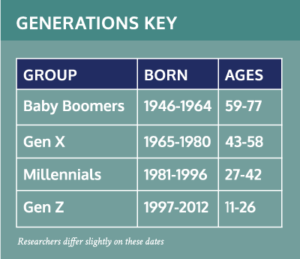
Catalyst: As you younger leaders have assumed leadership, what has changed in terms of how Crossroads shapes ministry?
Andy, Gen Xer
I’ve been in full-time ministry for 28 years, and I’ve seen different phases of ministry come and go. In our old silo mindset, for example, Doug just went off and did missions and once in a while we would hear some good stories. But he didn’t get pulpit time, and missions wasn’t integrated with worship. Some of the healthy culture shift here has been because my generation, and definitely John’s generation, brings a mindset of collaboration and a strong desire to work together.
John, Millennial
Collaboration connected to discipleship offers new opportunities. If someone is doing an event, whether it’s men’s ministry or women’s ministry for instance, it’s everybody’s event. That allows me to use the event as a place to disciple people. And maybe we can suggest one of our missions partners to be a guest speaker, or we can promote a missions trip during the event. Collaboration avoids competition where everyone is running separate programs and vying to convince people to come to their event.
Doug, Boomer
Collaboration also means that John and I go to those working with youth, students, women, men, seniors, small groups, etc. and ask, “How can we help? What aspect of missions makes sense for you?” Then we look for opportunities that we have that are a match for them, and we prune ministries that aren’t getting traction, things that our people don’t seem to have a heart for. [See Doug’s previous Postings article: “Break Out of Your Missions Silo.”]
We did an audit as John became missions pastor to analyze changes that needed to accompany my passing the baton to him. One result was that John essentially rebuilt the missions council with younger members while making sure to retain those who were ready to embrace change with the new generation.
John, Millennial
I see tremendous benefit in the excellent foundation of missions here at Crossroads, so it was important to me not to throw out everything from the past. To start all over from scratch would not be prudent or beneficial for what we are trying to build. But approaches do need to be modified for the next generations.
Catalyst: Andy and John, what is changing as your generation takes leadership? How do you lead differently and avoid creating chaos in transitions?
Andy, Gen X
I feel like my Gen X generation as a whole doesn’t need a lot of hand holding and accolades along the way. Younger generations generally need more reassurance and personal touch. They need a lot more time to build rapport. With my personality, I can move pretty quickly. But if I’m not careful, I can make changes and move the vision forward too fast, missing opportunities to encourage and give the younger generations more of the personal touch.
For example, I can just go to Doug and say, “Hey, we’re going to do these four things next week. His generation has respect for the leader’s role. He will ask questions and maybe offer ideas, but we can agree and move on quickly. But if I go to John, he will ask, “Well, why are we doing that? What’s the reason behind it? What’s the mission?” Those are great questions to ask. It’s just a different mindset. Both are needed. Both are good.
I personally have to keep flipping the switch in my head depending on who I’m talking to. If I’m not careful, I can come across to the younger generation as too matter of fact and that’s a turn off. Needless to say, I do a lot of lunches and breakfasts and coffees with people right now! This guiding along the way takes time but is crucial.
John, Millennial
I do always ask why. But as long as you give me a why, any why, even if I disagree with it, I’ll say, “Okay, you’re in authority, so you make the decision.” But I do want to know that you thought about it carefully. A lot of my generation though will have to agree with the why or really understand how it’s connected to the big picture.
Actually it’s often a question of the why for any generation. Sometimes leaders are married to a method but they have forgotten what the original reason was. Clarifying why that method was used in the first place makes it easier to transition to a new method. We can say, “We’re still addressing the same issue but in a different way that works better for younger generations.”
Andy, Gen Xer
I like how you worded that, John. I would add that knowledge of how to function administratively has to be learned by the younger generation. For example, there’s an etiquette to email, to phone calls, to follow up; I guess you could call it etiquette of ministry. The next generation communicates almost entirely through text and social media. To communicate with a broad spectrum of generations, they have to learn how to write emails with capital letters and punctuation or they are going to look ignorant. We can learn these things from the older generation.
On the other side, the savviness of the next generation is incredible. They can grasp things very quickly and use technology, AI, all these tools so effectively. And they can process really fast. So they bring a lot of strengths, too.
Catalyst: What have you learned as you integrated multiple generations into one leadership team? What advice would you give others?
Andy, Gen Xer
Two pieces of advice I would have for those looking at transitions. First, remember that discipleship takes time. Play the long game; really disciple people. Investing in people takes time. It’s not quick.
Second, I heard a long time ago that “the people who got you here may not be the ones who get you there.” Don’t be surprised when people choose to leave. During every transition it’s going to happen. That’s where ministry calling and grit come in. Refuse to be discouraged because as we’ve seen, when people leave, God brings the next people in.
Doug, Boomer
We Boomers need to recognize when it’s time to hand off leadership. We need to give the next generations room to make mistakes but also admire all they are doing right! Stay on board for the ride. Be teachable—I’m learning so much now from younger leaders.
John, Millennial
The three of us all have our opinions, personalities, and generational views, but ultimately we and the whole staff here at Crossroads must be willing to set aside our opinions to achieve the bigger vision and help the church grow. When we have unity as a team, we surface some good ideas out of our differences and usually discover some new things along the way. That mentality is really essential to make multi-generational collaboration successful.
Making Multi-Generational Leadership Work in Your Church
This discussion of Crossroads’ generational transitions focused primarily on people in staff positions. But the differences in perspective and leadership style apply equally to lay leaders. Here are some questions to ask regardless of whether you are in a large church with missions staff or a small congregation where missions is led by a team/committee working with your senior pastor.
- Ask Millennials and Gen Zers to describe how they perceive the leadership culture in your church. What changes do they think would make your church more attractive to other potential leaders their age?
- How could your church be more intentional about discipling and preparing future leaders? Name several people who would be good mentors.
- Have an honest discussion about the missions leadership positions in your church currently held by Boomers. Should these be transitioned to younger leaders in the next 2-5 years? What steps could you take now to identify and prepare replacements?
- How could your missions leaders and/or staff determine what to keep and what needs to change to make missions attractive to all generations in your church?
- Do you need an outside coach or consultant to help you think through transitions and adjustments in order to be more inclusive of all generations in your missions leadership? How could you determine who could best help you?
Andy George joined the staff at Crossroads Fellowship in 2005 and served as student pastor, campus pastor/Wake Forest, and associate senior pastor before becoming senior pastor at the end of 2016.
John Frye IV grew up at Crossroads and has been on staff for six years as an intern, coordinator, and now missions pastor. As missions leader, he particularly appreciates Crossroads as a multi-cultural, multi-generational, community-partnership-minded local church.
Doug Gamble, as missions pastor at Crossroads for 23 years, recently transitioned to a new role as city reaching pastor. His new job allows him to focus on his greatest passion and gifts—walking alongside local ministry leaders and church members serving across Raleigh.