share postings
April 2026 | Volume 21 | Issue 4
As missions resources multiply around the globe, increasingly complex collaborations seek to maximize what each entity brings to the task. Indigenous leadership is proving key to the long-term success of these multifaceted partnerships.
The Three Waves Movement is one such collaborative effort seeking to combine three very different missional forces, or waves, in South America. These waves came sequentially but each continues to impact missions endeavors across the continent today: the first—a foreign (largely North American) wave of missionaries and churches, the second—a wave of engagement by Latino/national churches and networks of churches, and third—a growing wave of visionary indigenous churches and networks.
Determined to collaborate better, churches, individuals, and networks from each of these three waves have come together under the Three Waves Movement banner to develop strategic alliances in six South American countries. Their shared vision is to reach and disciple the 400+ tribal nations of the Amazon and South American lowlands.
A coordinating team includes four indigenous, four Latino, and four foreign facilitators. They organize various cooperative efforts driven by clear values and a flexible structure based on high levels of trust. To explore why and how such a complex effort fosters effective collaboration, Postings interviewed facilitators from each of the three waves as well as the missions pastor of a Three-Waves partner congregation in the US (see below).
César Rodríguez Sáenz is an indigenous pastor in Colombia and a key leader in the Three Waves Movement. “Because there is so much diversity in the Body of Christ,” he says, “we need to learn how to work together. The Three Waves Movement is an effort to live out that cooperation in a way that reflects and grows the Kingdom of God.”
Javier Mayorga Ramírez is a Colombian national who leads the facilitation team and coordinates ministry efforts across the Three Waves Movement. He adds, “There is a tremendous difference between working with the indigenous communities versus working in them. Westerners and Latinos work in indigenous communities when they come in with their own plans, materials, and structures. In contrast, in the Three Waves Movement, we are committed to walking alongside the indigenous church as they lead.”
Chris and Tina Ferry are the facilitators responsible for helping North American churches bridge significant cultural and language differences in order to participate successfully in the Three Waves Movement.
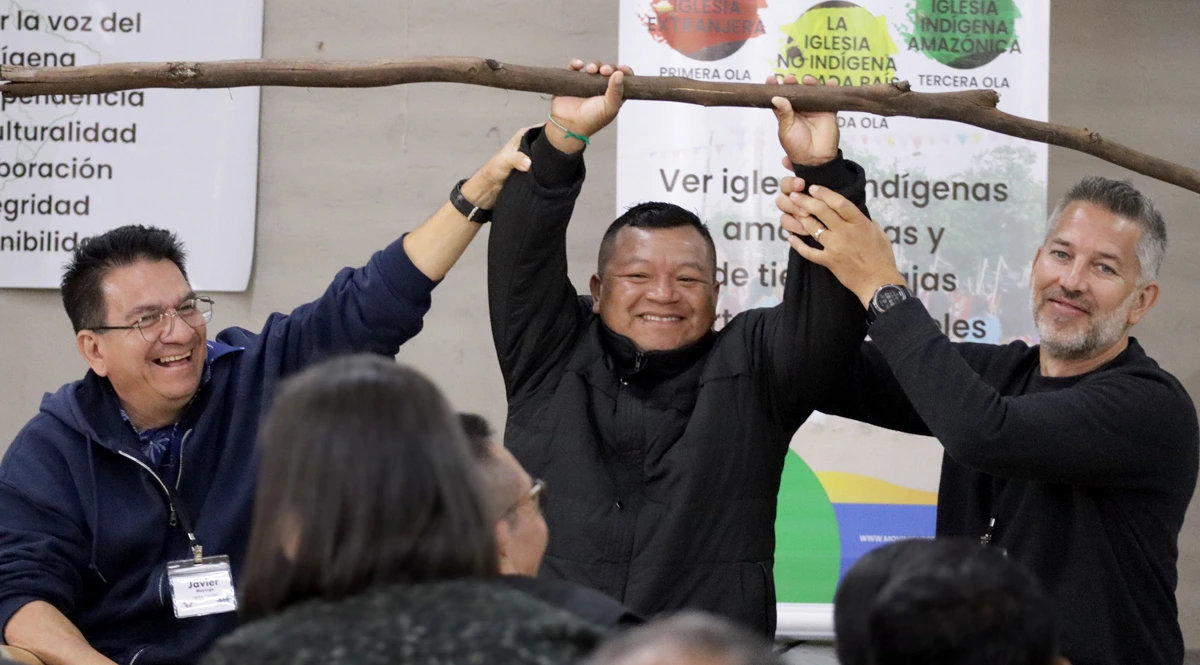
Javier (left) representing Latinos, and Chris (right) representing North Americans, hold up the arms of César (center) representing the centrality of indigenous leadership in the Three Waves Movement.
The Genesis of the Movement
Chris describes what surfaced the need for this collaborative effort: “The Three Waves Movement was born when missionaries began to hear from indigenous leaders that they had been marginalized even in missions work in their own region. Indigenous leaders felt like employees rather than partners. Their faces were being used to raise funds for initiatives from which they failed to see benefit.
“They were tired of transactional models and of being brought to the table after the plans had already been made. ‘We have the same Holy Spirit as you do,’ they reminded their Western and Latino brothers and sisters. While a few partnerships in the region were relational and modeled collaboration, in general there was significant duplication and territorialism,” Chris reflects with sadness.
But Chris continues on a more positive note: “The Three Waves Movement was born when a few key leaders recognized that if a truly collaborative effort was to address these problems, Latino and North American missionaries and church partners would have to move to the background. Their role would need to shift to providing behind-the-scenes coaching and support while ensuring that indigenous leaders were heard and publicly visible. American and Latino partners would have to learn to accompany, not dominate, the indigenous peoples who would take the lead to initiate what they saw was needed.”
American and Latino partners would have to learn to accompany, not dominate, the indigenous peoples who would take the lead to initiate what they saw was needed.
What makes such a complex combination of groups and leaders work? Each of these facilitators emphasize that relational, interdependent partnerships rather than transactional approaches are the key.
Javier explains, “The Movement revolves around these strategic values: prioritizing indigenous voices, interdependence, interculturality, collaboration, integrity, and sustainability.”
“We have found that there are a lot of aspects of partnerships that you can’t control, but if partners share the same values, it keeps the quality of ministry at a high level,” Chris adds. “These values Javier just listed are essential filters for Three-Waves ministry because they direct and protect us.
An American Church’s Experience in Three Waves
Postings talked to Bo Myers, missions outreach pastor of Church at Sandhurst, a Three-Waves partner in Florence, SC. Here’s what he shared with us.
Paul Johnson, a long-time Sandhurst member, was key to launching what is now the Three Waves Movement more than three decades ago, and he led the coordination of efforts for many years. Paul wanted our church to understand that the philosophy of those doing missions on the ground needed to change. He demonstrated and helped us grasp the concept that missionaries and partnering churches needed to respect indigenous leaders and follow their lead. We trusted Paul and have been supportive all along the way.
Before stepping into missions leadership here at Sandhurst three years ago, I had been a long-time member and then in a different staff role. So I already understood the vision and values of the Three Waves Movement when I took this position. I knew that we were committed to responding to what the indigenous partners identify as a need we can help meet.
For instance, we learned that some of the Three Waves networks were looking for leadership training, so two years ago, we sent a team to Ecuador not to do training but to observe what they were already doing. We went as encouragers; we went to build personal relationships.
Last fall, after again listening and discussing with them what would be most effective, we sent a team to Bolivia that partnered with a work project, and one of our female leaders also led a time of reflection for the women’s group during the training conference. We engaged in this way because that is what they asked us to do.
This is just one illustration of how our congregation understands that first we must invest time and travel to listen to what the needs are on the ground. Then we can respond to specific requests. Over the years, we have been asked to do a wide variety of things from assisting with an evangelism outreach to putting on a new roof. Whatever it is, if we can, we respond when our partners ask.
Our congregation understands that first we must invest time and travel to listen to what the needs are on the ground.
Tina emphasizes that the Three Waves Movement functions within the tensions that come naturally when partners with different languages and cultures are trying to work together: “On one hand, collaboration is slow and glitchy because dialog among multiple partners often requires translation into different languages, and that automatically slows down the dialog. But on the flip side, multiple languages also enrich the experience.
“Bringing together different cultures often leads to some confusion and misunderstanding,” she continues. “However, those differences are intrinsic to who we are, so we are committed to operating within those cultural differences and tensions at every level.”
Tina adds with a wry laugh, “We have come to realize that if we aren’t experiencing some tension and frustration as we work across barriers, maybe we aren’t actually facilitating a collaborative environment like we claim we are.”
Qualities of an Effective Western Partner
Given the difficulty of bringing together three very different “waves,” it’s important to ask what makes a Western/North American church a good candidate for engagement in this type of effort.
Chris lists some key attributes: “First, church partners must be relationship focused. As Javier explained earlier, relationships—not projects or programs—are at the center of any effective collaboration in this part of the world.
“The second essential is a posture of coming alongside to assist our indigenous partners rather than telling them what to do.” Chris goes on. “Western churches serious about being good partners first come to see what God is doing on the ground; they don’t arrive with their own plans.”
“Westerners like to go on missions trips where they can be the up-front presenters,” Tina admits. “Yes, they might be better equipped to teach, preach, or lead a training. However, if they are seen as the experts, they sideline and create doubts about the competency of local leaders.
So in the Three-Waves model, the Westerners’ equipping and coaching happens behind the scenes so that the indigenous leaders are the ones up front leading the process. For the North American, it’s not glamorous and they can’t claim any of the results, but it is far more effective.
Westerners might be better equipped to teach, preach, or lead a training. However, if they are seen as the experts, they sideline and create doubts about the competency of local leaders.
“Measuring success therefore can get very sticky,” she goes on. “It’s a dance because the people in the congregation back home need to understand that the missions trip has contributed significant value while at the same time the team members must avoid imposing their ideas or their success measure onto the culture where they serve.
“Our pace in partnership is often different, too,” Tina emphasizes. “By ‘pace,’ I mean the time we are willing to invest to build the relationship and clarify what God wants us to do before even beginning to work together. North Americans’ pace is much faster than that of the cultures we are serving. Western churches love efficiency. But in partnering, they have to intentionally choose to slow down and be patient. They must rely on partners to define the realistic timeframe to see our shared goals accomplished.”
Facilitators Are the Ligaments
The conversation then turned to the role of facilitators.
Javier offered an analogy. “Our facilitators are the ligaments that connect the parts and allow for movement to happen.”
“Yes, the facilitators are cultural interpreters,” Chris agrees. “They work to make sure the communication is clear, and they serve as a cultural filter to help all participants not just hear words but understand intention.”
“Javier’s ligament illustration is so appropriate,” Tina says, rubbing her fists against each other to demonstrate. “Our jobs as facilitators can be fatiguing because our various partners are eager to move forward, but in the process, they often unintentionally rub against each other like bone on bone. As the connecting ligaments, facilitators get very stretched because we love each partner, and we have compassion and empathy for what each is experiencing.
Facilitators are cultural interpreters. They work to make sure the communication is clear, and they serve as a cultural filter.
“To change the metaphor,” she continues. “In the process of mediation, the partners sometimes want to ‘shoot the messenger’ because they aren’t fully pleasing anyone. So facilitators must have a strong sense of identity in Christ and keep in view that they are serving the Lord and not man.”
César describes one place tensions can occur: “Sometimes our local people are pushed by Western partners to do something they are not equipped for or should not be doing. In such cases, our network leaders have to intervene in order to protect the indigenous churches.”
“Or sometimes they leave out the local leaders,” Javier adds. “Here’s an illustration. We had one Western organization that came in to do training under the umbrella of the Three Waves Movement. But once on site, the trainer ‘threw away’ our indigenous leaders and took over himself.” The pain is obvious in Javier’s voice. “The indigenous leaders just felt used.”
“However, indigenous people in our region are very uncomfortable with confrontation,” Tina says, picking up the narrative. “The indigenous church is learning biblical models of confrontation, but it is very hard for them, especially with Western partners. That’s why facilitators are essential to help in situations where there is hurt or anger that isn’t expressed; it’s where the strength of the Three Waves comes in.”
Tina explains how it works: “César navigates and facilitates the situation when it involves the indigenous churches in Colombia; Javier facilitates the relationships with the Latino churches; we facilitate situations with Western churches. Despite the fact that we are supporting each other as we deal with these painful scenarios, we still recognize that resolving conflict is emotionally exhausting for leaders like César.
“One of the areas where there is often friction between partners involves finances,” Tina points out. “Western churches often exclude partners from finance and budget conversations because they are uncomfortable sharing the numbers with them. But we need to be open and just trust the process of mutual discipleship in money matters too. It’s the facilitator’s role to bring both sides along in this to make sure the relationship is open and healthy.”
We need to be open and just trust the process of mutual discipleship in money matters too.
“Let me share a positive example of how our partnership works well,” Javier chimes in. “We asked one of our American church partners to help us train leaders to be catalytic—to think not just locally but also globally. They first came and listened carefully to what we were asking for. Then over a period of a couple of years, we built and adjusted curriculum together. They helped to provide funds to rent the training space. After the training, they followed up with the leaders to see how they were doing with implementation. This is how true collaboration works here.
“I have been blessed by working with so many different faces, and all of them reflect Christ,” Javier continues. “This Three Waves Movement was born out of the need for change. Leaders saw that the indigenous churches needed to grow and respond to the Great Commission. But the same is true for the Latino national churches and the foreign Western churches. Our goal is to foster the growth of all partners by providing spaces for unity, true cooperation, and training of catalytic leaders.
Our goal is to foster the growth of all partners by providing spaces for unity, true cooperation, and training of catalytic leaders.
“This is a response to Jesus’ prayer in John 17:21 for unity in the Body of Christ,” Javier concludes. “When we are walking together in this unity, it shows that we are brothers and sisters, and this is both a reflection of our unity with Him and such a wonderful method of impacting those watching us. If people who need our message see God’s diverse children walking in unity, they will know that we are sent by God. So there is an amazing evangelistic component to our working together in the Three Waves Movement—three very distinct cultures walking together and living out biblical values together.”

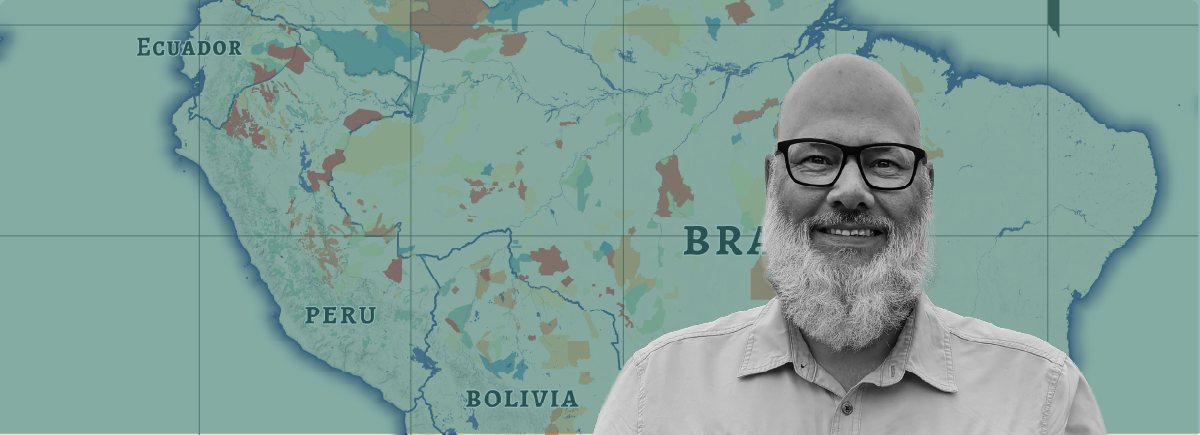
César Rodríguez Sáenz, an indigenous pastor and missionary to Amazonian people groups, is also president of the network of Christian Indigenous Leaders of the Colombian Amazon (LICAC) and vice-president of the Trans-Amazon Network that forms the indigenous heart of the Three Waves Movement.

Javier Mayorga Ramírez coordinates Latino church engagement for the Three Waves Movement. He has ministered among indigenous people for more than 20 years and is passionate to see Latino churches effectively collaborate with indigenous leaders across the Amazon and lowland regions.

Chris and Tina Ferry coordinate the engagement of North American churches in the Three Waves Movement. Their years of experience as missionaries in Ecuador were essential preparation to help Westerners actively listen to, develop genuine relationships with, and serve alongside indigenous leaders.

Miss an issue? Here are the most recent Postings

Missions Stewardship
https://catalystservices.org/wp-content/uploads/2026/09/September-2026-Web-Cover-1200x675-1-1024x576.webp 1024 576 https://catalystservices.org/wp-content/uploads/2026/09/September-2026-Web-Cover-1200x675-1-1024x576.webp
10 Ways to Improve Your Missions Serve
https://catalystservices.org/wp-content/uploads/2026/07/July-2026-Cover-1200x675-1-1024x576.webp 1024 576 https://catalystservices.org/wp-content/uploads/2026/07/July-2026-Cover-1200x675-1-1024x576.webp
Don’t Ignore Half of the Great Commission
https://catalystservices.org/wp-content/uploads/2026/05/2026-may-cover-1200x675-1-1024x576.webp 1024 576 https://catalystservices.org/wp-content/uploads/2026/05/2026-may-cover-1200x675-1-1024x576.webp
Can Three Diverse Missions Forces Collaborate?
https://catalystservices.org/wp-content/uploads/2026/04/prayer-circle-cover-1200x675-1-1024x576.webp 1024 576 https://catalystservices.org/wp-content/uploads/2026/04/prayer-circle-cover-1200x675-1-1024x576.webp
Avoiding the Boneyard
https://catalystservices.org/wp-content/uploads/2026/03/Military-Boneyard.3.26-1024x576.webp 1024 576 https://catalystservices.org/wp-content/uploads/2026/03/Military-Boneyard.3.26-1024x576.webp
You Gave Me Food and Visited Me
https://catalystservices.org/wp-content/uploads/2026/02/Feb2026-Cover-1200x675-1-1024x576.webp 1024 576 https://catalystservices.org/wp-content/uploads/2026/02/Feb2026-Cover-1200x675-1-1024x576.webp
Raise Your Church’s Missions Temperature
https://catalystservices.org/wp-content/uploads/2026/01/Jan-2026-Postings-Cover-1200x675-1-1024x576.webp 1024 576 https://catalystservices.org/wp-content/uploads/2026/01/Jan-2026-Postings-Cover-1200x675-1-1024x576.webp
Best Missions Books of 2025
https://catalystservices.org/wp-content/uploads/2025/12/December-2025-Cover-1200x675-1-1024x576.webp 1024 576 https://catalystservices.org/wp-content/uploads/2025/12/December-2025-Cover-1200x675-1-1024x576.webp
Understand Your Missionary’s Support
https://catalystservices.org/wp-content/uploads/2025/11/Nov-2025-Postings-Cover-1200x675-2-1024x576.webp 1024 576 https://catalystservices.org/wp-content/uploads/2025/11/Nov-2025-Postings-Cover-1200x675-2-1024x576.webp
Introducing Newcomers to Missions
https://catalystservices.org/wp-content/uploads/2025/10/newcomers-cover-1200x675-1-1024x576.webp 1024 576 https://catalystservices.org/wp-content/uploads/2025/10/newcomers-cover-1200x675-1-1024x576.webp
Choose Your Missions Lenses
https://catalystservices.org/wp-content/uploads/2025/09/Sept-2025-Cover-1200x675-1-1024x576.webp 1024 576 https://catalystservices.org/wp-content/uploads/2025/09/Sept-2025-Cover-1200x675-1-1024x576.webp
Missions and the Mom-and-Pop Agency
https://catalystservices.org/wp-content/uploads/2025/08/mom-n-pop-cover-1200x675-1-1024x576.webp 1024 576 https://catalystservices.org/wp-content/uploads/2025/08/mom-n-pop-cover-1200x675-1-1024x576.webp
Honest Conversations–Part 2
https://catalystservices.org/wp-content/uploads/2025/07/July-2025-Cover-1200x675-1-1024x576.jpg 1024 576 https://catalystservices.org/wp-content/uploads/2025/07/July-2025-Cover-1200x675-1-1024x576.jpg
Honest Conversations–Part 1
https://catalystservices.org/wp-content/uploads/2025/06/honest-conversations-cover-1200x675-1-1024x576.webp 1024 576 https://catalystservices.org/wp-content/uploads/2025/06/honest-conversations-cover-1200x675-1-1024x576.webp
An Integrated Outreach Model
https://catalystservices.org/wp-content/uploads/2025/04/Jesus-Mission-Diagram-w-back-1200x675-1-1024x576.webp 1024 576 https://catalystservices.org/wp-content/uploads/2025/04/Jesus-Mission-Diagram-w-back-1200x675-1-1024x576.webp
Steward Your Lifestyle
https://catalystservices.org/wp-content/uploads/2025/02/Hobelman-Brothers-1200x675-1-1024x576.jpg 1024 576 https://catalystservices.org/wp-content/uploads/2025/02/Hobelman-Brothers-1200x675-1-1024x576.jpg
Take Your Missions Team Higher
https://catalystservices.org/wp-content/uploads/2025/01/mountain-climbers-1200-675-1024x576.jpg 1024 576 https://catalystservices.org/wp-content/uploads/2025/01/mountain-climbers-1200-675-1024x576.jpg
Best Missions Books of 2024
https://catalystservices.org/wp-content/uploads/2024/12/Best-Books-2024-Cover-1200x675-1-1024x576.jpg 1024 576 https://catalystservices.org/wp-content/uploads/2024/12/Best-Books-2024-Cover-1200x675-1-1024x576.jpg
Internships
https://catalystservices.org/wp-content/uploads/2024/11/Postings-Cover-November-2024-1200x675-1-1024x576.jpg 1024 576 https://catalystservices.org/wp-content/uploads/2024/11/Postings-Cover-November-2024-1200x675-1-1024x576.jpg
What Global Churches Can Give Western Partners
https://catalystservices.org/wp-content/uploads/2024/10/Passing-Basket-web-1200x675-1-1024x576.jpg 1024 576 https://catalystservices.org/wp-content/uploads/2024/10/Passing-Basket-web-1200x675-1-1024x576.jpg
Thinking Collaboratively
https://catalystservices.org/wp-content/uploads/2024/09/Web-Cover-Sept-2024-1200x675-1-1024x576.jpg 1024 576 https://catalystservices.org/wp-content/uploads/2024/09/Web-Cover-Sept-2024-1200x675-1-1024x576.jpg
Integrating Discipleship and Missions
https://catalystservices.org/wp-content/uploads/2024/08/August-2024-Cover-1200x675-1-1024x576.jpg 1024 576 https://catalystservices.org/wp-content/uploads/2024/08/August-2024-Cover-1200x675-1-1024x576.jpg
I Might Be Interested In Missions
https://catalystservices.org/wp-content/uploads/2024/07/postings-july-2024-cover-1200x675-1-1024x576.jpg 1024 576 https://catalystservices.org/wp-content/uploads/2024/07/postings-july-2024-cover-1200x675-1-1024x576.jpg