

January 2022 | Volume 17 | Issue 1 |
Discover and Connect Young Global Leaders
Christian Mungai envisions the future of missions in a new generation
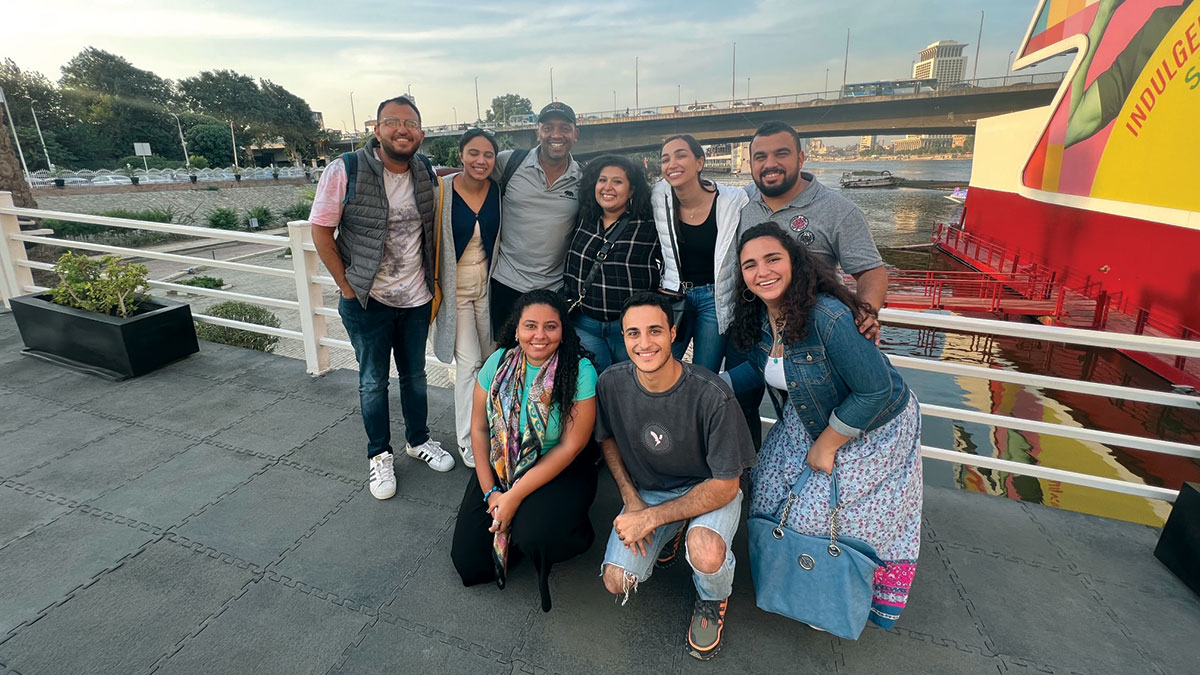
Christian Mungai (back row, third from left, with young Egyptian leaders) represents a new kind of American church missions leader—an immigrant who brings an outsider’s perspective to how Western churches should engage in missions. After growing up in relative poverty in Kenya, Christian came to the US as a musician and eventually was invited to reshape the missions engagement of Mariners Church, one of the largest and fastest growing churches in America. Postings recently interviewed Christian to learn more about how his connections to the global church, especially younger leaders, is shaping how he leads Mariners into a different missions future.
 You are investing so much of your energy into young global leaders these days. What image comes to your mind when you think about them?


Lots of people say they know a global leader or have a global partner. My definition of a global leader is what I call “the 5 percent.” Here’s what I mean by that: Seventy percent or more of global church leaders are living in abject poverty, so often they view the Western Church as a means to an end, as primarily a source of financial resources to escape their dire circumstances. This type of relationship works because the Western Church has a great need to be needed; they want to know that they are having an impact and making a difference.
Then you have another 10 to 25 percent of global leaders who are at the helm of an organization. While they are great leaders and well respected, in many cases they are simply following in the footsteps of the Westerners who went before them and are leading in the same way. Sadly, they often don’t have a vision for something new because they are comfortable in what is familiar and what has personally benefitted them.
The remaining 5 percent are bold enough to challenge the Western precedents. They are confident enough to say “thanks but no thanks” to both Western models and money. I call them “dangerous leaders” because they already have a vision for their own context and beyond, and they understand that the Great Commission is as relevant for them as for the Western Church. They recognize that they, too, have a mandate to go to “their” ends of the earth.
So how does the American church connect to those you describe as this 5 percent?
The 5 percent are not out there looking for relationships with Western partners because they are busy doing their ministry. And honestly, I don’t think most Americans have the fortitude to work with them because any Westerner truly partnering with them is engaging for mutual and reciprocal impact, and humbly following their lead.
For example, one Egyptian leader has initiated work in 25 countries in the Middle East; another from Sri Lanka works in 13 countries in Southeast Asia. One “church father” in Mongolia, who is just 35 years old, is building an Asian leadership development network with the goal to engage young leaders across Asia.
Bishop Oscar Muriu (along with Nairobi Chapel) and Pastor Muriithi (along with Mavuno Church) in Kenya have a vision to plant culture-defining churches in their cities, across their continent, and in gateway cities of the world. And they are doing it! That’s a big vision! Everyone thinks that it’s impossible. But that is what global leaders do—they call us to things that are impossible. What if rather than push back with “I’ve never seen that happen, so we can’t do it,” we said, “Okay, that’s impossible, so how do we work with you to make that vision actually come to pass?”
The challenge becomes how to help churches across the West work with this very small demographic of leaders. For starters, I would like to get a few leadership-level American churches to work with one global partner around a collective vision and see how that would change the face of missions.
However, big churches often don’t dance well together. The bigger you are, the less likely you are to dance well with others because you’ve been successful in your own certain way. And that puts you into into a box. But in a few instances, we are beginning to see collaboration among megachurches happen.
Do you see a larger number of new-paradigm leaders coming up in the next generation? On the global side, do you see the 5 percent becoming 25 percent?
Yes! Because the 5 percent is very geared to creating new leaders. They have not just one but two generations of younger leaders under them whom they are empowering. These younger men and women are not looking to the West for leadership. They are following the 5 percent.
Since 2013, we have had 31 young global leaders come to Mariners Church for a year-long global residency program. Each global resident has to be recommended by one of the churches within our network of current global partners.
Even during COVID, Mariners had one resident from Mongolia, one from southern Sudan, and one from Kenya. These young leaders are challenging our thinking and our way of doing ministry at Mariners. Our priority is to help them become who they need to be. For example, they are very smart, but they’re not credentialed because they haven’t been able to afford it. To make advanced degrees possible, Mariners is starting a scholarship fund so that they can get educational credentials.
A number of our global church partners watched what was happening with our residency program and asked, “Can we create that residency experience in two churches somewhere around the world every year? So in the last two years, our church partners from Kenya and Egypt each hosted global residents for six months and then they came to Mariners for another six months. Mariners covered much of the cost. What residents are learning under other global leaders is invaluable.
How could that be implemented by smaller churches? Can they have a role in helping to nurture the next generation of global leaders?
What if every church decided to do a residency program? The Global South church is made up of a predominantly younger generation; there are lots of younger leaders. Bring several together at one time in order to invest in who they are, to learn from who they are, and to connect them to each other. They will empower each other! A residency program is a missions strategy built not around sending but receiving. Receiving is part of the Great Commission.
We need everyone to move forward toward a new model of global collaboration. No church is too small nor too large.
Say a Western church has been connected to partners in the 70 percent category who primarily see them as funders. Is there a way that that the Western church can help to identify and nurture next-generation men and women who have the potential to be godly, visionary leaders?
I don’t have a full answer. But I would recommend starting by looking for what God is already doing. Ask the best global leaders you know who they identify as promising younger leaders. Don’t start with your agenda. I notice that some American church missions leaders hold very tight control on their partnership program because they have seen bad things happen in the past, and they think they need to make sure those mistakes aren’t repeated. But we need to release control.
At age 47, I see this control tendency in myself. I’m in the past generation of missions pastors. The innovation is going to come from the next generation of leaders so I have to stop thinking that my way is the only way and my models are the only models.
How can I get out of the way and empower the next generation of leaders? One example is that I was blessed by our leadership to move from missions pastor into a role as global-movement pastor with a focus on engaging with interested churches and organizations to rethink global missions and catalyze global movements. As Mariners then considered who should be the next missions pastor, I suggested that we look inside our church because I was watching how several of our people were already effective leaders.
In so many contexts around the world, God is doing powerful things with insiders. I am constantly meeting new leaders who are just blowing my mind because of what they are doing in their own context. For example, on a trip to the Ukraine I met two amazing young leaders, one of whom was featured in a Hollywood movie. Yet nobody here knows about him; he has no Western supporters. He’s just doing amazing things with the people and resources that he has. Or I think of another who works with gangs in the favelas of Brazil. Westerners don’t know about him either, but I believe that God may use him to change what is happening across the nation of Brazil.
Some sharp young leaders are from the 70 percent who are mired in dire poverty, but they have a mindset driven by a different paradigm. They aren’t swayed by our big buildings or how we do things. They grew up in poverty, but they don’t see the West as their answer. They are discovering local solutions for local issues and creative ways to pass on the gospel. They know what God wants them to do in their context and they are boldly moving ahead. And many times they are in touch with other young visionary leaders like themselves. Find one and they will point you to others.
What do they need that will help them become powerful leaders despite their circumstances? Some people suggest that we need to create an institute with content curated from key global leaders. However, it’s important to remember that most Westerners learn through reading while most global leaders are experiential. Experiences are what are transformative.
What do we as Westerners need to remember when we connect to a high-potential global leader?
I think we must break the American individualism and the mindset of exceptionalism. We’re proud that “My church does this. My church does that.” Instead, we need to be ready to collaborate on someone else’s agenda.
For example, the churches in Katy, TX, collaborated when the hurricane struck. Every church contributed something. One did food. Another clothing. Another furniture. They said it was because they had been praying with each other for the past 17 years. When the crisis came, it was easy to decide that each church should focus on meeting one need. I think that’s how we move forward.
Collaboration requires structure though. You need somebody to play the convener who brings people to the table. And we have to trust each other. That involves challenging each other, praying together, crying together. At the end of the day, we ask, “What is the one thing that we can do together that we can’t possibly do apart?” None of us can be a global family by ourselves. The Kenyan church cannot be a global family by itself, nor can the American church.
What should a global family do? We at Mariners got together with our global church partners and agreed that we needed to create a movement of the next generation of globally minded disciples from every sector of society. Senior global leaders chose and commissioned six young leaders—all Millennials—representing strategic regions of the world to be an executive committee. The goal is to double the size of this core team with visionary men and women representing an additional six key regions.
Each member of this executive team has identified three people they will disciple and three additional young leaders who are each capable of mentoring three of their peers. We also began introducing people to each other. For instance, we connected one of my guys who runs an Apple store here with a young man in Sri Lanka who wants to influence the political arena. They found so much in common and can’t wait to meet each other in person. I am excited to see what God does with relationships like these!
While I function a lot in the megachurch world, I appreciate the value of smaller churches. They have a lot of potential, and one of their advantages is that they can change faster and easier than a church the size of Mariners. They may be less assured that they have the answers and therefore ready to collaborate. We need everyone to move forward toward a new model of global collaboration. No church is too small nor too large. We listen and learn when we are sensitive to what God is doing in our day in the global context. I love that!