

August 2016 | Volume 11 | Issue 8

Handling Information Wisely
Security guidelines in an open-network world.
It’s likely that some of your global workers serve where becoming a Christian is forbidden. Your national partners may have to worship in secret. Can you safely communicate with them and tell their stories in your church? How can you handle sensitive information wisely?
We can’t get our congregation engaged with our people-group focus because we can’t talk about them!
I can’t write our workers because I don’t know what I’m allowed to say.
Have you expressed or heard these frustrations about the difficulty of communicating about/to those in a security-sensitive region of the world?
It is hard but not impossible to talk about what God is doing in such places and to maintain good communication with people in those locations. But the enemy would like to convince you that it’s not possible. Our goal in this issue of Postings is to help you develop a plan so that you and your congregation can connect powerfully to people/places around the globe that probably need the most prayer.
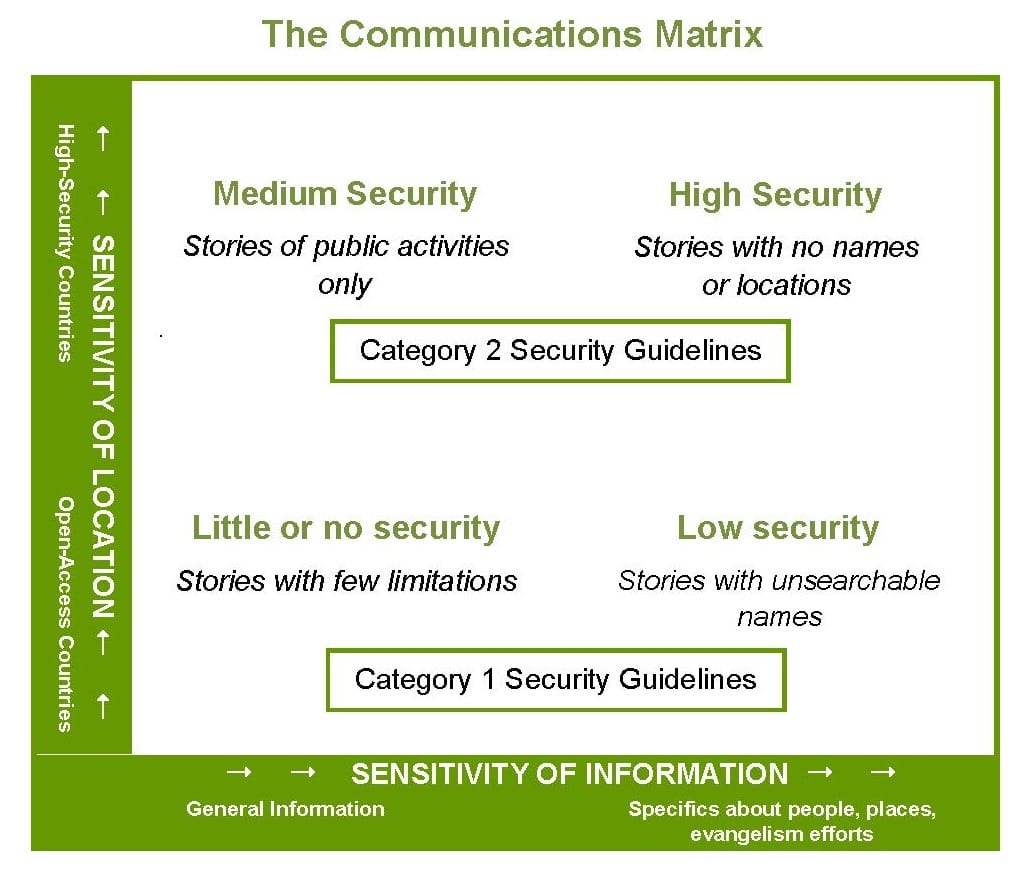
SENSITIVITY OF LOCATION
Open-Access Countries
Nations or regions that allow total freedom of religion and open missionary work is accepted.
High-Security Countries
Nations or regions where any type of overt Christian outreach is forbidden and Christians are persecuted.
SENSITIVITY OF INFORMATION
General Information
Descriptions of activities not associated with specific people or evangelistic efforts. Activities of workers that they themselves make public.
Specifics about People, Places, Evangelism Efforts
Information about spiritual outreach by/to named individuals. Descriptions of any activities that might be objected to by local authorities (government, religious, family).
EMPHASIS ON STORIES
Note that in each quadrant above, we describe information in terms of stories. Stories are far and away the most powerful way to communicate about your global involvement. It is stories, not facts, that will grip the hearts of your people. Thinking in terms of stories will also help you realize that by shielding the identities/locations of those involved, you can communicate powerfully to your congregation.
Basic Principles of Information Flow
Live and work with integrity
As much as possible, we want to conduct our lives and ministry in an open and forthright manner. We should be covert only when obedience to Scripture requires ministry involvements which, if revealed, could endanger the life or work of others.
Always speak with respect
In everything we say, we want to show love and respect for others. Believers should always speak graciously about those who practice different beliefs, and whose culture and lifestyles may be dissimilar from their own. Anything we say or write should pass this litmus test: Would the people I’m talking about be offended by either the content or the tone of my words? Regardless of whether the message is intended for them, this test is appropriate.
Don’t be overconfident of technology
Recent international events have made clear that little or no electronic communication is guaranteed to be private even with elaborate encryption systems. Therefore, it may be wise to assume that even messages sent through “safe” means may be read by others. Remember that initials and abbreviations are only to avoid e-mail scanning devices; they will not fool anyone who opens your email. Communicate with the assumption that someone in surveillance could be listening/reading.
Defer to field workers’ preferences
The people most likely to be impacted by the sharing of information should make the decision regarding how and with whom it can be shared. Ask field workers and follow their preferences. This includes those serving in what you may consider low-security contexts.
Be consistently vigilant
It’s easy to relax and send a message or post an announcement without thinking about whether particular words are precisely acceptable in a certain context. However, in missions communications we need to practice consistent self-discipline even in small details. What we say or write, even a quickly dashed-off email or a comment made in jest, can be misunderstood and can cause great harm.
Find creative ways to tell the story
Do not allow security concerns to defeat the process of drawing your congregation into the narrative of what God is doing around the world. You can veil the specifics of location and people while still telling powerful stories of God’s work in the lives of real people. One author recently wrote an entire book about a church’s partnership in a high-security location. She vividly described real people and situations throughout the narrative—without divulging the place or people group. It can be done!
Don’t shrink from regular, meaningful dialog
Take security precautions but don’t allow them to hinder the flow of powerful communication with your workers and partners. Don’t avoid getting involved in a strategic ministry because security protocols are required. Be persistent in helping your congregation master and implement the guidelines.

Develop Wise But Workable Communications Guidelines for Your Church
Step #1: Identify the appropriate security category for each of your workers/partners
Tentatively place each global worker/partner in either the (1) no/low security or (2) the medium/high security category.
Step #2: Establish security guidelines for personal interaction WITH your workers
Communication between you and those in category #1 may be totally open, but not for those in category #2. Develop appropriate guidelines. Suggested guidelines are provided in our Communications Security Package (see below).
Step #3: Establish guidelines for sharing information ABOUT your workers/ministries
Determine guidelines for private, public, and internet communication. Suggested guidelines are provided in our Communications Security Package (see below).
Step #4: Confirm communication preferences with each of your workers/partners
Check with each member of your missions family to see if they concur with the category where you have identified them and agree with the corresponding guidelines. Remember that the guidelines themselves are sensitive. For workers in high-security areas, you may need to confirm this information with them when they are with you rather than emailing it to them for review.
Step #5: Develop a security guidelines implementation plan
Who needs to understand your completed guidelines? How will you make sure they are communicated and implemented? Suggestions are provided in our Communications Security Package for the congregation, print/electronic media gatekeepers, and those speaking in public services (see below.)
Communications Security Resources Package for Churches
- Basic Principles and Important Facts
Key concepts your missions team needs to keep in mind as you develop communications guidelines
- Security Protocols
A sample set of guidelines for communicating with, and about, those in the no/low and medium/high security categories; also a sheet of language suggestions for high-security areas
- Steps to Implementing Communications Security
How to establish, share, and maintain safe practices
- Global Worker Preferences Questionnaire
Questions to discover/confirm worker-specific communication guidelines
- Communications Quiz
A fun way to help short-term teams understand communications protocols in high-security regions - Sample Guidelines
Sheets you can customize for (A) the congregation, (B) print/electronic media gatekeepers, and (C) those who talk about or pray for workers in public services.