

July 2017 | Volume 12 | Issue 7 |
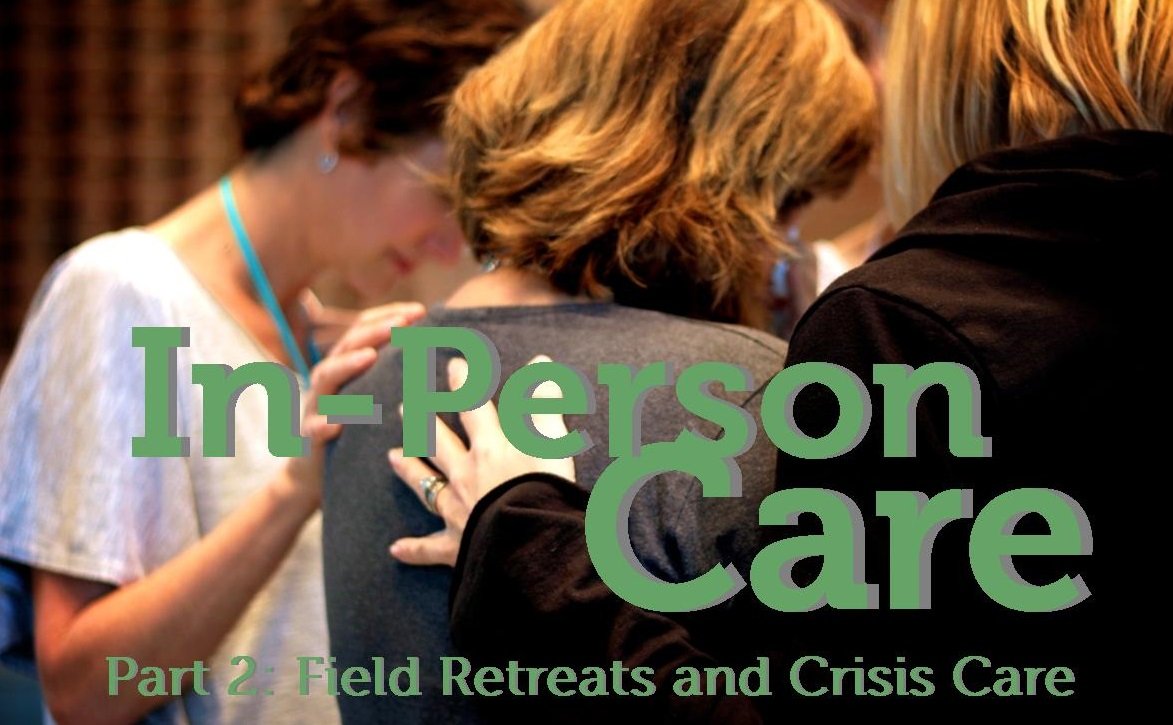
In Person Care Part 2:
Field Retreats and Crisis Care
Part 1 of this 2-part series addressed the regular, on-field care that global workers need from their sending church. In this concluding article, we focus on special care opportunities: field retreats and crisis care.
ON-FIELD RETREATS
Recently Highlands Community Church in Renton, WA, piloted a regional retreat for their missionaries in the Ukraine. Its success has encouraged them to repeat this event in other places. Missions Pastor Tom Dabasinskas describes how they gathered both their US-sent workers and nationals for a time of learning about their ministries, providing soul care, and just pampering. The planning process began with two questions for their field partners: What areas do you want to be equipped in? Where do you want to partner more with us? The program and the staffing grew out of these expressed needs. The cost of a nice hotel and good food were covered by the church. There were times of worship and caring for adults but also activities for kids.
They gathered for a time of learning about their ministries, providing soul care, and just pampering.
Highlands hopes to run this type of event in a different part of the world every other year. The plan is to make it part of a year-long focus on that particular global area. A field worker from the region will kick off the focus by speaking at their October World Outreach event. The congregation will then be invited to engage in multiple ways. One opportunity will be to serve on the regional-retreat planning team or staff. Sponsoring the regional retreat will help to increase the congregation’s understanding of, and involvement in, ministry in that part of the world. Both the church and its field partners will benefit!
 Carol Snell, director of worker care at Woods Edge Community Church in Spring, TX, has helped to plan and coordinate two different types of on-field retreats. In one case, Woods Edge was asked to organize a retreat in the Middle East for a large missionary team, some of whom were sent from their church. The other mini-retreat gathered all of the Woods Edge workers serving in Europe and the Middle East.
Both retreats were well received and the church is now planning another. Carol recommends that special attention be given to providing excellent childcare and children’s programming so that parents can fully engage in the activities. Clear advance communication is also key so that everyone knows what to expect. This includes the purposes of the retreat, the type of facilities needed, and what expenses are being covered by the church vs. by the workers themselves.
EMERGENCY OR CRISIS CARE
Crises and trauma come in a myriad of forms for missionaries. They may involve political turmoil, a natural crisis such as an earthquake, a serious illness or even death, a family crisis, or other traumatic event involving the worker, their family, their team members, or national colleagues.
Prepare in advance
 “We encourage our missionaries to join agencies that we know are good in providing crisis care,” Pat Coyle of Grace Bible Church, College Station, TX, explains. “We know this is not an area of our expertise, but we want the agency to be good at it.”
Sending churches should be proactive in asking agencies for their crisis response plans for the area where their worker is serving/will serve. Request specifics about their perspective on the role of the sending church in times of crisis, and make sure this view is shared by field and home-office personnel. Ask them to describe a recent emergency situation and how the worker’s sending church was involved. Then determine if you as sending church are satisfied with the role they outline for churches. Clarify with your workers how they want you to be involved in an emergency.
Sending churches should be proactive in asking agencies for their crisis response plans for the area where their worker is serving/will serve.
Make sure you know what costs the agency will cover in the event of an emergency, especially if evacuation is needed. Is there insurance coverage for some expenses? If your missionary is responsible to cover major costs, discuss with them the amount of buffer or contingency funds they are reserving for such needs.
Ask which agency leader (1) in the home office and (2) on the field you should interface with if an emergency arises. Make sure that you have a phone number where these people can be reached 24/7. Review the list annually with each agency because personnel change frequently.
What if your worker is serving with an agency that does not have the capacity to provide well-developed crisis-management and member-care services? If that is the reality, you as the sending church need to seriously evaluate the responsibility you carry if that worker encounters an emergency situation on the field. We live in an increasingly unstable world. You will want to soberly consider your spiritual responsibilities as well as legal and financial requirements to be adequately prepared to address a crisis.
 David Livingston, pastor for global outreach member care at Bethlehem Baptist Church in Minneapolis, MN, shares, “You need to be particularly sensitized to workers who live in situations where there is constant threat of significant trauma. You don’t want to be caught unprepared, but it’s hard to stay in front of the curve.” Talk to your workers about what it means for them and for you to be well prepared.
Ready to go
A number of years ago, one church was contemplating sending a team of workers to a very difficult region of the world. They decided that the missionaries might be ready, but the church wasn’t prepared to care for them adequately in such a volatile setting. So they decided to hit the pause button. With careful planning, they beefed up their crisis-care training and then developed a team of people with various types of skills who could be called on to drop everything and get on a plane immediately if needed. Only when they considered their care-capacity sufficient did they send their workers to the field.
David explains that Bethlehem has at least two leaders who are always prepared to hop on a plane and head to crisis situations on short notice. And a speedy response has been crucial on several occasions, as in one situation where hands-on support from the church was needed by a worker whose life was threatened.
Multiple churches confirmed that they have set aside contingency funds earmarked to cover expenses such as airline tickets to put caregivers on the ground immediately in an emergency. Knowing funds are available eliminates one source of concern at a time when there are more important things to address.
Set aside contingency funds earmarked to cover expenses such as airline tickets to put caregivers on the ground immediately in an emergency.
Triage with the agency
Tom encourages churches to work closely with the agency to triage a crisis situation. Sometimes that can be accomplished via phone calls but it may require onsite evaluation. However, Tom cautions that the amount and quality of agency care varies dramatically from agency to agency. In one recent situation, their worker’s agency was stellar at providing care and in collaborating with the church. In another instance, the agency had no concept of engaging the sending church in addressing the crisis.
 Darlene Jerome, international coordinator of the Mobile Member Care Team, has spent decades assisting field workers dealing with crisis situations. She reminds churches that they will be most effective if they step into traumatic situations with humility and a servant attitude. She notes that partnership in these contexts is essential—everyone needs to respect what others bring and defer to those with extensive experience.
When a crisis occurs, churches need to ask what needs aren’t being addressed, what they can do well, and at what point in the trauma they can be of greatest help. Emergencies are often fast-moving situations. That means being ready to move quickly and also ready to shift plans at a moment’s notice. Sometimes the church’s greatest service comes when the immediate crisis is over yet the worker is still dealing with the aftermath.
Care for caregivers
When asked if any church had specifically reached out to care for her in the years she had regularly served in the midst of profoundly intense situations, Darlene couldn’t think of a single instance. Care-giving is immensely demanding. How could your church thank and refresh a team leader, area leader, or counselor who has served unselfishly through a crisis (or many of them)?
One church leader noted that they support a worker who serves in a very high-stress care-giving role in an agency. “She is under an unsustainable level of pressure,” he said solemnly. “Something is going to have to be done about that.”
A word to the wise: Make sure your caregivers as well as your global workers are in situations where they can flourish.
You can find part 1 of this In-Person Care series here.