

April 2023 | Volume 18 | Issue 4
Partnership Not Sponsorship
Reciprocal benefits enrich a 20-year relationship
Fairhaven Church in Dayton, OH, entered a three-way partnership two decades ago with a small network of churches in the suburbs of Quito, Ecuador, and an organization called Church Ministries International (CMI). Twenty years later, the partnership is a multi-faceted, growing relationship that has succeeded specifically because it is not a one-way sponsorship.
Postings’ Ellen Livingood recently sat down with three people who have been deeply involved in this partnership to learn what makes it healthy and effective after all these years.
 Inge Lise Valencia is CMI’s country coordinator for Ecuador and also a member of one of the partnering churches in Quito, Ecuador.
 Kirk Lithander served as a missionary prior to 2002 when he became outreach pastor at Fairhaven Church, a Christian and Missionary Alliance (referred to as the “Alliance”) congregation in Dayton, OH.
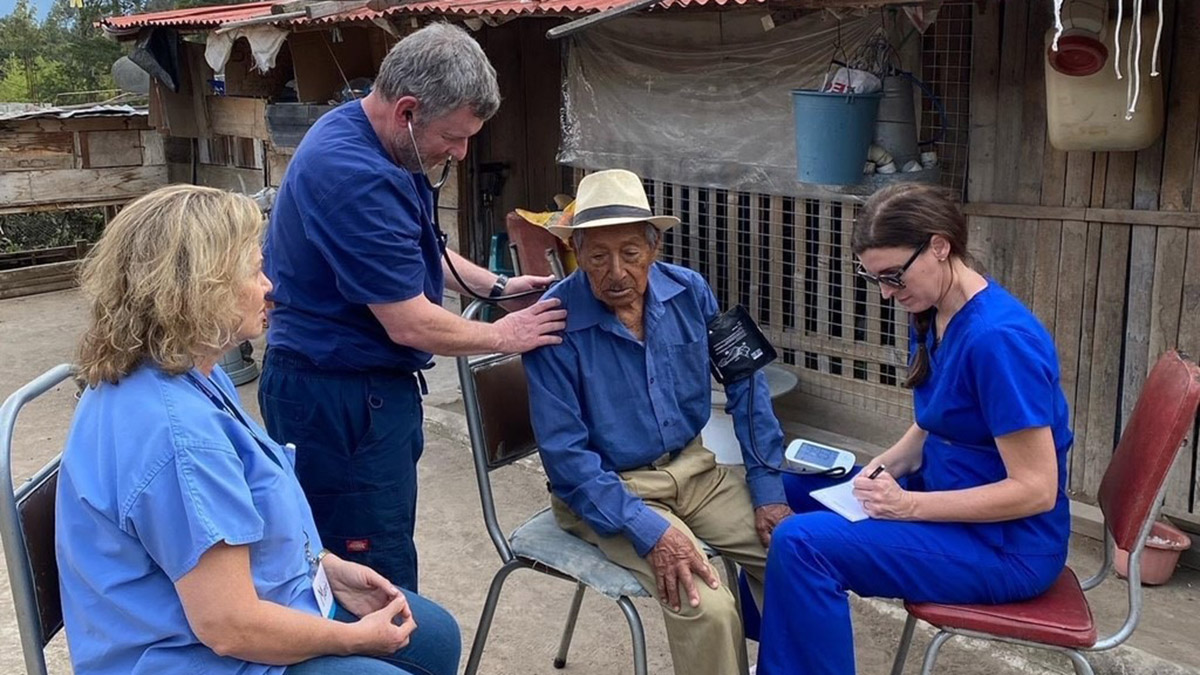
 Dr. Bob Smith, a pulmonary and critical care physician in Dayton, is an elder at Fairhaven and has coordinated the medical aspect of this partnership for the last 18 years.
Ellen: How did this partnership launch? Take us back to the beginning.
Kirk: Fairhaven supported Ricardo and Gloria Diaz, a missionary couple working with several larger Alliance churches in Quito, Ecuador. In 2003 they invited me to come on a discovery trip planned in conjunction with CMI. We were immediately drawn to these churches because the visit revealed that we had similar goals and philosophy of ministry.
We also recognized that as a large, upper-middle-class church we had much in common with these upper-middle-class Ecuadorian churches. Another factor that made this a good partnership match was their need for leadership development. The Alliance was reassigning some of their workers from Latin America to harder-to-reach countries, leaving a void in the continuing development of Ecuadorian leaders that we were able to address. These points of alignment encouraged us to form a relational and strategic partnership with one of these congregations.
CMI has always played a central role. They had a long history of partnerships that planted churches in more well-to-do urban areas of South America with the conviction that these churches had the potential to evangelize the rest of their country. While they were successful on the field, their US church partners were really just financial sponsors. More relationship building was needed. Eventually we all came to be aligned in this relational direction, and our partnership has developed into a stable, three-legged stool connecting churches around Quito, churches in North America, and CMI.
Inge Lise: From the beginning, Ricardo asked me to help him coordinate partner visits, and he was adamant that the participants would stay in the homes of our people here. We knew that deeper relationships would develop if they were hosted in our homes rather than a guesthouse.
The partnering churches here are primarily made up of professionals who are new believers. Hosting a Fairhaven team in their home and then working alongside them throughout their visit made a huge impact on our people because we were working together as a united force to serve needier communities. And it was crucial for our people to understand that pouring yourself into what God is asking you to do not only impacts the community, but also your own life and your family’s.
“Hosting a Fairhaven team in their home and then working alongside them throughout their visit made a huge impact on our people because we were working together as a united force to serve needier communities.” Inge Lise
Ellen: Bob, how did the medical work fit into this? I understand that at the beginning you weren’t fully on board and had to be convinced?
Bob: Initially I was a cynic when it came to medical short-term missions. I didn’t see how traveling to a remote region for a week, handing out medicines, and coming home was going to have a lasting impact. On my very first trip to Ecuador, however, God dealt with my medical arrogance and showed me that this ministry wasn’t about medicine or my medical training. Instead, it was about the potential for deep relationships that have a real impact.
After that first trip, I became the medical team leader. We didn’t start with a detailed strategy of where we wanted to be in 10 years. Rather, our relationship evolved as God brought new people and new opportunities to the partnership. After 20 years, we have a year-round partnership of which our annual, one-week medical mission remains a major outreach focus.
“This ministry wasn’t about medicine or my medical training. Instead, it was about the potential for deep relationships that have a real impact.” Dr. Bob Smith
Ellen: How has the medical work brought together resources from both sides?
Bob: About three or four years into our partnership, one of the newer Alliance churches in Quito developed a vision to minister in a poor area near them. Their dynamic young pastor developed a strategy to use our medical mission trips to not only serve the poor but to get the attention of the medical professionals who lived within the reach of their church. He even arranged for television coverage showing us working together to serve the needy. Then this pastor asked if they could occasionally send three or four physicians to stay in our homes for a week and make educational visits at our local hospitals.
We developed that idea and made it high profile on our end. When the Ecuadorean doctors visit, they are taken around the hospital by doctors who have been on one of our short-term teams. That creates opportunities to talk about what we do in South America. Later in the week, we host an informal gathering for the visiting doctors and some of our local medical staff. Fairhaven leverages the Ecuadorians’ visit for impact with our medical professionals here. The result is that the partnership expands both partners’ impact on their own professional community.
Ellen: What a win/win situation! What other relationships have been developed?
Kirk: Reciprocity is always a high value for us. Fairhaven has sent some of our staff to Quito, including our senior pastor, to do teaching and training. We’ve also invited the pastors from Ecuador to come here. For instance, worship leaders have come and challenged us by their style and fervor in worship. Our youth have also connected well, and so have some businesspeople.
Inge Lise: When our pastors go to the US, they are able to observe and then put much into practice in their own churches. For example, we were able to see how the US churches work with refugees. In Ecuador, we have a lot of refugees from Venezuela. Even though our leaders are serving different needs in a different culture, there are a lot of things that Fairhaven is doing that we can emulate.
Bob: Those who attend Fairhaven hear frequent references throughout the year regarding our Ecuadorian partnership. Whenever someone from Ecuador visits, it’s not just a quick recognition in the service. What makes an impact are the personal connections made as people chat in the coffee shop or connect at an evening gathering. The depth of friendship goes way beyond merely supporting somebody in another country.
Our lead pastor, David Smith, has been to Ecuador several times. He grew up as a missionary kid and is fully committed to our partnership model. Since the pastors there don’t really have a role model for leading a large urban church, he has been a mentor offering advice on small and large issues.

Ellen: Few partnerships survive very long without a really good facilitator. What is Inge Lise’s role in all of this?
Bob: We absolutely couldn’t do it without her! You can’t effectively manage a partnership in a country where you don’t know the culture. You need to be able to rely on someone you have confidence in. She makes good decisions and takes care of everything. When I talk to other churches about this model, I emphasize that they must build the cost of a facilitator into their budget. The amount of work required demands more than just token reimbursement.
Kirk: Inge Lise is an effective liaison because she understands both the American culture and the Ecuadorian culture and is fluent in English. She is that essential bridge between our short-term teams and the Ecuadorian churches.
Inge Lise: Thank you. To be honest, I love what I do. Yes, it’s work, a lot of work. Sometimes I’m exhausted at the end of a medical team’s visit, but my heart is filled with joy because I really have a passion. I thank the Lord that I can use my skills and talents to serve Him in this way.
Ellen: Unanticipated problems surface in even the best partnership, and at times mistakes are made that can be turned into learning experiences. Has that been true for you?
Inge Lise: Last year, there was a serious problem with one of our pastors, and the church was falling apart. Pastor Dave Smith personally flew to Ecuador and took the time to talk one by one with a lot of hurting families, many of whom he already knew personally. He spent five days here. It was a big, big thing to us that he would do that.
One correction we had to make was adding follow-up after the medical teams were here. When we realized how important it was to do both medical and spiritual follow-up, we set up a system for doing it well.
Bob: We learned that our medical teams could be too large. One year we had a team of almost 60 people, and I saw what that did to Inge Lise. We learned that 30 is a good size for us. We also learned that while you can include some team members who are not yet Christ followers, you can’t include too many on one team.
Kirk: It’s also crucial to manage expectations. Since Fairhaven is a megachurch, our partners could be tempted to assume that we will give unlimited amounts of money. One Ecuadorian doctor wanted us to build a big medical center and put his name on it. We had to clearly communicate that our goal is not to build buildings but to supportively serve what the local churches are doing.
Ellen: You have instituted regular evaluations to make course corrections, I believe.
Kirk: We have a debrief and evaluation after every short-term trip. And in each of our international partnerships, we stop every three years and ask whether what we are doing is helpful for our partners. Are we meeting expectations? Where do we need to make changes? Do our partners still want us to come? We will not go where we’re not invited.
Success Factors for Fairhaven’s Church-to-Church Partnership
- Launched from shared goals and philosophy of ministry
- Built on relationship not money
- Supported by a three-legged stool: indigenous church, US church, facilitating agency
- Focused on ministry done together
- Intentionally created around reciprocal benefits
- Coordinated by a highly qualified facilitator
- Kept on course by the discipline of regular evaluation and the flexibility to evolve over time
Ellen: You have recruited a couple of other US churches to engage in this partnership and are open to that. But your major partnership expansion has been with one of your satellite churches. What does that look like?
Kirk: Our Springboro campus is now partnering with another Alliance church in Ecuador. It’s been fun to see this satellite campus really get excited. Now every year they send their own team of medical professionals. We want to plant a similar
vision at our other campuses.
Ellen: What final advice do you have for other churches that want to consider this partnership model? Maybe they realize that they have been more of a sponsor than a partner. How do they shift to a reciprocal, sustainable model?
Kirk: Ministry flows out of relationship; partnership flows out of relationship. For instance, serving the needs of the 2,000 patients that the medical team may see on a given trip is important, but it’s really about developing relationships and coming alongside our national partners and doing what they want us to do.
Bob: For many reasons, including the history of short-term missions, it is easy for Latin churches to feel inferior if North American brothers and sisters just come down and complete projects. A successful partnership must be reciprocal. From the beginning, you need to talk about how each group is going to help the other. Our Ecuadorian partners need us North Americans to come and give their church more credibility in the eyes of their community. We need the partnership to help our people look beyond Dayton because we have developed deep friendships with brothers and sisters in Ecuador.
Inge Lise: Everyone must be flexible and resilient. There will be bumps on the road, so everyone must be able to adjust.
“A successful partnership must be reciprocal. From the beginning, you need to talk about how each group is going to help the other.” Dr. Bob Smith
Ellen: Thank you all for taking the time to share what you have learned over the past two decades in this partnership. Your model abundantly proves that it’s worth replacing sponsorship with partnership.