

May 2024 | Volume 19 | Issue 5
What Kind of Partner Are We Looking for?
Third in a series of guidelines for initiating healthy partnerships
“We met this amazing pastor/leader who needed financial support, so we became partners.”
“Our pastor’s friend urged our church to become a partner in the ministry he was involved with overseas.”
Ask many churches how they chose their indigenous global partners and a version of one of these methods will often be the answer. Sadly, the partnerships that are launched with such limited considerations are often also limited in their value to either partner.
A reminder: Our simple definition of a church partnership is a relationship of trust that connects local churches across cultures in mutual giving and receiving to achieve shared Kingdom-building goals. The first in this series of articles on how to launch a healthy partnership focused on “Are We Ready to Partner?” The second addressed “What Is the Purpose of Our Partnership?” Please carefully consider these first two steps before moving on to the third critical step which we explore here: “What kind of partner are we looking for?”
Not just any global church or ministry is the best potential partner for your congregation. And your church is not the best potential partner for just any indigenous church or ministry. Before turning our attention to our checklists of important partnering alignments, let’s consider some underlying factors that have a major impact on partnership success.
SUBJECTIVE ELEMENTS OF PARTNERSHIP
- Time for relationships to mature. Even if a partner seems to be a perfect match, it’s essential not to rush the process but to patiently invest in building the relationships. Partnerships are grown, not created overnight.
- Availability of a strong facilitator. The value of a good facilitator cannot be overemphasized. Many relationships fail not because of any fault of the partners but because they have lacked sufficient help to identify and overcome cultural and language barriers.
- The subtle issue of personal chemistry. It is especially helpful if the pastor of your church and the pastor of your potential church partner feel kinship and are eager to walk together in this relationship. It’s hard to predict and impossible to engineer personal affinity, but usually it doesn’t take long in face-to-face interaction to determine if they feel a personal connection.
- The Holy Spirit’s endorsement. This sense of affirmation is achieved through earnest prayer before the final choice. Often there are confirmations that are clearly not humanly designed. God is bringing your churches together for His purposes!
As you look at the following lists of alignment issues, remember that a potential partner who ticks all of the boxes is not automatically the right partner. Rather, it means that you are ready to begin a conversation that may lead to a partnership as trust is developed.
A potential partner who ticks all of the boxes is not automatically the right partner.
PRIMARY PARTNERING ALIGNMENTS
Is your church ready to take the next step toward finding the right partner? Here are partnership factors you will want to consider. If your church is looking to partner with an individual or organizational ministry rather than with a church, the questions may be somewhat different. Space limits our ability to address those here.
| Area of Alignment for Potential Partners | To Better Understand This Alignment Factor | |
|---|---|---|
| 1. | Matching Partnership Goals. Assuming that your church has clarified your partnership goals (see the list of 8 potential purposes), how do these match your prospective partner’s goals? | Carefully listen to the heart and vision of the indigenous church leaders before describing your own goals. Otherwise, they may feel pressured to just agree out of courtesy or a desire to gain the financial support of a partner. A good facilitator who understands your culture and church as well as your prospective partner’s can help you evaluate the alignment of goals. |
| 2. | Theological Agreement. Are you comfortable partnering with any church that affirms basic orthodox beliefs? Or must your partner church ascribe to the same theological positions as your church holds? | How would you define “basic orthodox beliefs”? Would affirmation of the doctrinal statement of the Lausanne Covenant or a historic creed be sufficient? Or would a prospective partner need to be a member of your denomination or have a particular theological viewpoint? It is important to note that in many parts of the world, theological issues are different from those in North America, and in places where there are few believers, fellowship is priceless and transcends secondary differences. |
| 3. | Position on Specific Issues. Do you have strong views on (1) financial transparency and accountability, (2) gender identity issues, (3) the role of women in the church or any other issue on which you would require agreement in order to partner? Do you have statements on such issue(s) that you would want a potential partner to embrace? Or can you disagree on these issues and still work together? | Christians in other parts of the world may not only hold different positions but see them as more or less important than your church does. How will differences impact your ability to work together? Where are ministry lines drawn that could reduce your effectiveness as partners? It is far better to surface these issues now than after a partnership has been forged. |
| 4. | Particular People Group, Religious Bloc, or Location. Do you feel God is leading you to partner with a church that is working among a specific people group, those of a particular religion, or those who live in a geographic region for which you are burdened? | Your church might choose to seek a partner in a specific people group, religion, or area of the world because of an immigrant group near you or one with which you already have experience in ministry. Or it might be the opposite: You want to broaden your vision for the world by focusing on a location/religious bloc/people unfamiliar to you. |
| 5. | Partner Visits with Your Church. Are you expecting that leaders from your partner church will visit your congregation? If so, are you willing to invest funds to cover their travel expenses if necessary? Are you willing to partner with a church where such visits are impossible due to government restrictions or other reasons? | Having representatives of your partner church visit exponentially expands the breadth and depth of your relationship. Are you ready to invest funds so that your entire congregation has an opportunity to better know key leaders and get a deeper understanding of their vision, ministry, and challenges? |
| 6. | On-Site Opportunities for Youth and/or Families. Are you looking to partner in a place where you can send teams of high-school or college-age youth, or families with younger children? | Developing the missions vision and cross-cultural ministry skills of younger generations in your church is an essential part of their discipleship process. However, many contexts, especially some most in need of Western partners, may not be appropriate for children or youth visits. |
| 7. | Opportunities for Extended Service Assignments. Do you desire a partnership that will offer opportunities for those who want to go for longer periods of time (generally 2 months-2 years) in an internship-type role where they will be discipled and trained by your partner church? Are you eager to partner in a location where long-term workers from your congregation might be needed? | As partnering churches build respect and trust, leaders often see the value of developing an internship program that offers opportunities for young adults to be embedded in the partner church to be discipled and introduced to cross-cultural ministry. A strong partnership often results in members of the Western congregation sensing a call to long-term service there. Is this a location where you want to send career missionaries? |
| 8. | The Prospective Partner’s Expectations. How does your potential partner want to bless and enrich your church through this partnership? What are they expecting, or at least anticipating, that your church will contribute to them? | No matter how small, or poor, or remote, every church has something, actually quite a bit, to give. A competent facilitator will help prospective partners to evaluate both their potential to give as well as their expectations of what they want to receive. |
| 9. | Sole Partner or Part of a Group Partnership. Would your church prefer to be the only international partner that your global church has? Or would you be comfortable joining with other Western churches to work together in a larger partnership where you could learn from others and serve alongside them? Are you considering working with multiple partners in the same region? Does the potential partner already have other partners? How would these factors impact your partnership? | This is an important but often complex question. Discussions with your facilitator may be the best place to begin. They will be able to explain the pros and cons of including multiple partners from the global/indigenous side and/or other Western congregations like yours. Clarifying expectations up front will avoid unwelcome surprises later. |
| 10. | Agency Requirements and Partnership Restrictions. If an agency will sponsor and/or facilitate your prospective partnership, what expectations and restrictions are they setting for your church and prospective partners? What will be their role in your partnership? | For instance, if the agency focuses exclusively on holistic needs (medical, educational, poverty alleviation, etc.), will they encourage your church to get involved not only in meeting those needs but also in supporting your partner’s evangelism and discipleship ministry? How much will they be involved in facilitating short-term trips and regular communication? |
SECONDARY PARTNERING ALIGNMENTS
Many of the global churches in greatest need of a partner are located in remote, challenging contexts. Western churches should carefully weigh their priorities and values before looking for a partner that requires little cost or risk. However, if this is your first partnership or there are extenuating circumstances that would threaten your ability to be a fully engaged partner, then you need to define these additional expectations up front.
| Area of Alignment for Potential Partners | To Better Understand This Alignment Factor | |
|---|---|---|
| 1. | Travel Costs. Would the cost of travel to visit a prospective partner prevent or severely limit your church’s trips there? | Easy-to-reach places can be flooded with visitors while more remote congregations have no prospective partners. Learning to trust God to provide funds to cover higher travel costs can be an area where He wants to grow a church’s faith. |
| 2. | Accessibility. Is the amount of time required to reach the partnership location a major issue for your people? A site that requires more than two days of travel to reach may be unrealistic if trips must be limited to one week of vacation. | If vacation time is a factor, churches need to beware of adopting a partner in a location where visits are realistic only for retirees or college students on summer break. |
| 3. | Safety. Must your partner church be located in an area that is considered politically stable and physically safe? Must readily available health care meet Western standards? Adopting a church partner in an unstable context demonstrates solidarity with brothers and sisters in Christ who often feel isolated and forgotten. | Churches must always exercise discernment in when/where they send their members. Sending youth into a potentially dangerous place is certainly unwise. At the same time, the Bible clearly teaches that the gospel mandate demands willingness to risk suffering. These are sobering issues to ponder in a world where the majority of the unreached live in countries increasingly hostile to the gospel. |
| 4. | Comfortable Living Standards. Do you prefer a church partner in a location where your people making on-site visits can expect to serve and be housed in a context that meets Western standards (i.e. phone/email connections, hot showers, dependable heat & A/C, good transportation, etc.)? | Even asking this question may seem inappropriate and entitled. Yet if you expect certain standards of comfort when you visit your partner, you need to voice them very early in the partner selection process. Don’t be surprised if your facilitator challenges you to be willing to endure some less-than-ideal circumstances that may still provide “luxuries” your brothers and sisters do not have. |
Partnering always requires flexibility, so it is a step of faith to allow God to stretch your church’s boundaries. At the same time, being honest and realistic will help you find a partner with whom you can serve well.
Partnering always requires flexibility, so it is a step of faith to allow God to stretch your church’s boundaries.
 Their Story
 Their Story
Multiple Steps to Finding the Right Partner
Eight years ago, with several fruitful global partnerships completed or well underway, Asbury Church in Tulsa, OK, sensed that God was asking them to respond to the devastating refugee crisis unfolding in the Middle East. The Syrian civil war was driving millions across the border into Lebanon, and Asbury had a desire to partner with a church or ministry there that was providing physical care while also sharing the gospel.
In 2016, a team from Asbury made a survey trip to visit potential ministry and church partners in Lebanon. The leaders they met were stretched far beyond their own capacities and looking for partners who would not only give financially but also walk alongside them as they opened their doors and hearts to desperately needy Muslim refugees.
Asbury was particularly drawn to one Lebanese pastor who was creatively reaching people in his neighborhood. The personal “chemistry” was good, and friendships quickly developed. However, the Lebanese pastor freely admitted that he did not have a vision for reaching out to the refugees around his church.
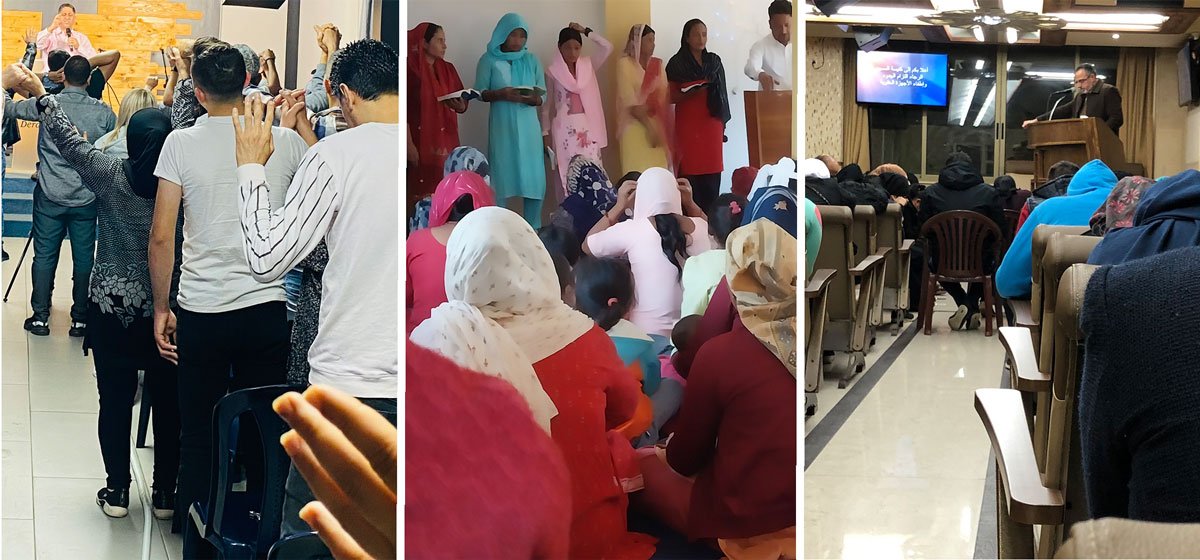
More prayer and discussion at Asbury reconfirmed that God was specifically calling them to a partnership focusing on refugee ministry. Reluctantly they decided that the first church they had been drawn to was not the right partner for them. A subsequent trip introduced them to the Christ Evangelical Baptist Church (CEBC) on the outskirts of Beirut. The church already had extensive weekly ministries to refugees in their area including a medical clinic, food and clothing distribution, etc., all coupled with gospel outreach.
There were lots of exciting possible collaborations. However, Asbury is a Methodist church and CEBC is strongly Baptist, so open discussions of their theological similarities and differences had to precede any partnership commitment. Could Asbury come alongside CEBC based on their strong agreement on the gospel essentials and commit to not making an issue of other theological differences? And could CEBC work under those conditions? The answer was yes. After prayerful consideration, both sides agreed they were ready and eager to partner.
Today, the partnership between Asbury and CEBC is deep despite the pandemic interruption and deteriorating security in Lebanon. Medical teams, pastoral visits, and young adult collaboration have all strengthened the bond between the two, while Zoom calls and WhatsApp messages keep the churches regularly connected. Asbury is also partnering with two organizations ministering to refugees and the displaced in the region. Clear partnering goals established at the beginning were essential in defining and developing these healthy, productive relationships in the Middle East.
Have questions about establishing a global partnership? Feel free to contact us. We are here to help you develop a healthy, cross-cultural relationship.